
← All articles · Palestine and Israel
The occupier's eagerness to execute the resister, the loneliness of Al-Aqsa Mosque and what the Church of the Holy Sepulchre tells
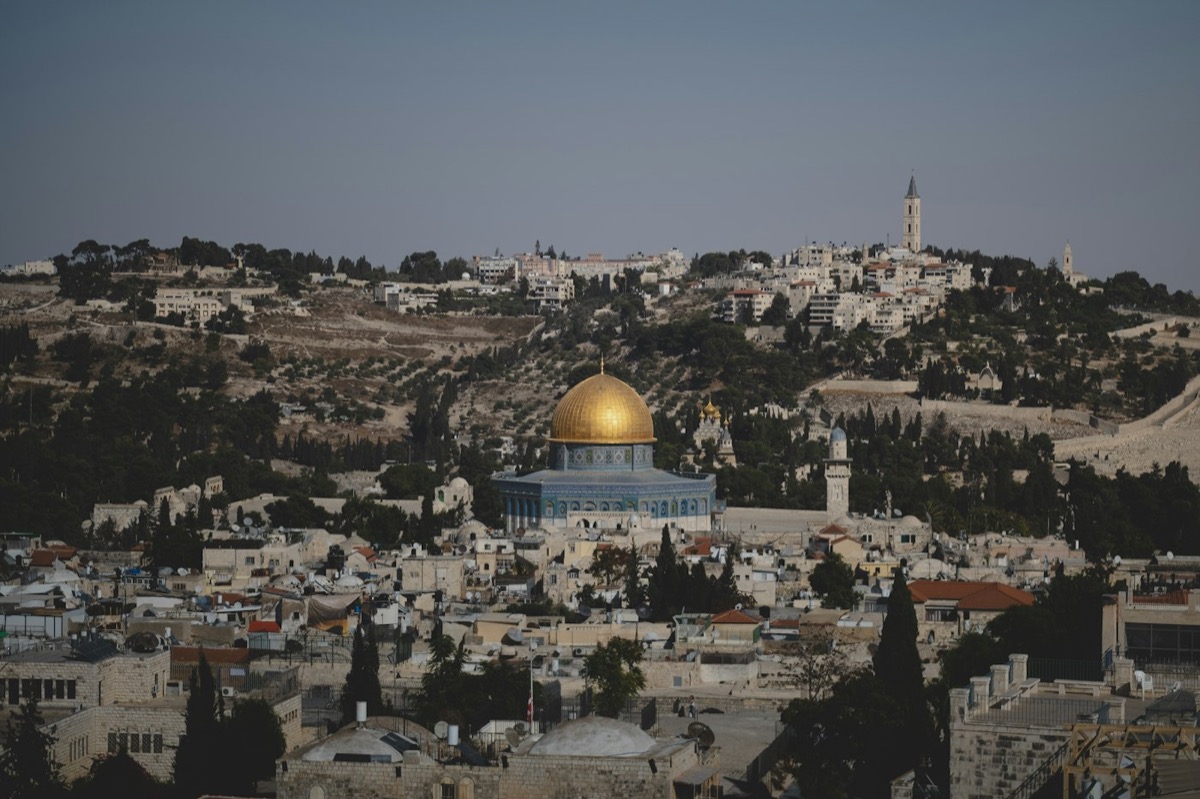
A blood-curdling law emerged last Monday evening from the Israeli occupation parliament, whose prime minister and many of whose officials, as perpetrators of genocide, should now be answering before international justice. Actually, calling it a law would be a great shame and an insult to every kind of legal activity. It is rather the murder order of a brigand structure that, by virtue of its occupier status, has no legitimacy and no legal basis whatsoever. The language of the order text is cold, technical and orderly. But what circulates between the lines is of course very far from the language of law: a distinction that separates the value of lives and reflects, at a more fundamental level, a racist bestiality. The same act produces two different outcomes for two different subjects. When what one does ends in death, it is a crime to be met with the heaviest penalty; when what the other does ends with the same result, it does not even fall into the same category. Thus it is not the crime itself but the identity of the perpetrator that becomes decisive.
According to the text of the law, the occupation state will be able to impose the death penalty on any Palestinian who kills an Israeli citizen; but under no circumstances will this penalty be applicable to an Israeli who kills a Palestinian.
The law, submitted by Itamar Ben-Gvir, leader of the far-right "Jewish Power" party and National Security Minister, and Nissim Vaturi, a Knesset member from the Likud Party, lays out all the steps of carrying out the execution in technical detail, with a cold-blooded murderer's fantasy. Accordingly,
* Method of execution: The sentence will be carried out by hanging, by a masked guard. This aims to conceal the identity of the person carrying out the execution.
* Full immunity: Those carrying out the execution will be granted full criminal and legal immunity; thus the guard becomes both "judge" and "executioner" at once.
* No right of appeal: Once a death sentence is issued, no commutation or cancellation is possible. A death sentence may be issued even without a prosecutor's request, and after the decision becomes final it must be carried out within 90 days.
* Full isolation: Those sentenced to death will be isolated in underground cells and no visitors will be admitted until the moment of execution.
The law targets Palestinians living in areas under Israeli control. The death penalty is envisaged for Palestinians convicted of intentional killing within the scope of "acts of terror," while life imprisonment is left to extremely exceptional cases.
A military court will be able to issue a death sentence without a prosecutor's request and without a requirement of unanimity. Israeli military commanders in the region have no authority to pardon, commute or cancel this sentence.
CAN THE OCCUPIER JUDGE THE HOMEOWNER?
Actually, technically, it is an always unacceptable contradiction for an occupying structure to legislate against the forces that resist it, which is the most legitimate right. Unfortunately, Israel has gotten its brigandage in the lands it occupies accepted, in Europe too, beginning with the US. Although the International Criminal Court has declared the Israeli Prime Minister a perpetrator of genocide, there is no one who can call Israel to account.
What kind of reaction will come on this matter from the EU, so sensitive about death penalties? So far we have heard no reaction. Will a reaction come from the European Union representatives who sound the alarm the moment the death penalty is uttered in Turkey, even in the context of crimes truly committed against humanity? Or will they brush it aside saying there is nothing to be done since Israel is neither a member nor a candidate of the EU? Were human rights valid only for EU member countries?
Though from whom do we expect what? No, we do not expect. Let us not act as if we did not know that the human rights discourse has no meaning other than being an instrument of foreign intervention and imperialism.
But let us not fail to say here that Israel's legislative move targets not so much the Palestinian people as 2 billion Muslims. Unfortunately, the silence of 2 billion Muslims in the face of Israel's insolence against the values of Islam is the real big trouble. The same Israel, which today, on top of what it has done in Gaza for three years, insults Muslims wholesale even with this decision, is about to draw some Islamic countries to its side in its aggression against Iran as an Islamic country. Those countries must come to their senses. On Israel's side there can be no good war against anyone, nor can there be. Iran, despite all its past sectarian practices, is a part of the Islamic world, and the war waged against it is a war waged not against its Shiism but against its Muslimness, against the entire ummah.
AND AT PRECISELY THIS POINT ANOTHER SCENE APPEARS
The Latin Patriarchate Vicariate in Jordan welcomed the reopening of the Church of the Holy Sepulchre in Jerusalem during Holy Week. Bishop Iyad al-Tawwal stated that Pope Leo XIV's stance expressing solidarity with Christians in the Middle East contributed to the church's reopening.
Bishop Tawwal also appreciated the Jordanian government's statement containing strong language. This statement had emphasized that access to all places of worship in the holy lands is the right of all believers. In addition, the patriarchate vicar, commending the positions of the Italian Prime Minister, the French President, Canada and the EU, once again emphasized that all believers have the right to access their places of worship without being subjected to any obstacle, insult or harassment.
That is, in the same geography, initiatives made for another holy place can yield results. Calls made for the opening of the Church of the Holy Sepulchre are answered. A solidarity voiced by a Pope, a bishop's statement, a government's harsh declaration, messages of support from Europe... All of them combine and the doors open. The believers' right to worship becomes an international issue and this issue is resolved.
No one can belittle this effort here. Freedom of belief, the right to worship, access to holy places... These are universal rights and must be defended.
But one cannot help asking this question: Why does the same sensitivity not appear for another holy place in the same geography?
In an environment where Al-Aqsa Mosque is violated every day, where acts of worship are restricted, where people's entry is blocked, why does the same voice not rise? Why does the same diplomatic activity not form? Why is the same determination not seen?
Isn't the answer to this question very clear?
NOT ONLY A LOSS OF POWER, BUT ALSO A LOSS OF REPRESENTATION
Muslims today are living through perhaps one of the most fragmented periods of their history. Politically splintered, lacking a common will, buried in their own internal affairs. Each speaks within its own borders, but a common voice cannot be produced.
This situation is not only a loss of power; it is a loss of representation.
There was once this representation. There was the caliphate, not only as a form of government but also as an office of speaking. When an injustice occurred, there was an answer to the question of who would speak against that injustice.
Today that answer is absent. Today Muslims are not only victims; they are also alone. And this loneliness is not only a situation imposed from outside, but also a result of internal fragmentation.
For this reason the tragedy lived today is not limited to the consequences brought by a law.
The real tragedy is this: While a people's life is being systematically devalued within an order, a strong and common voice cannot rise against it.
And this silence determines not only today but also tomorrow. Because when death becomes ordinary in one place, life begins to lose its meaning not only there but everywhere.