
← All articles · Palestine and Israel
Towards the anniversary of the burning of the Al-Aqsa pulpit: the unbearable misery of challenging Barghouti in prison
The famous Republican senator of the US, Nancy Graham, objected in a speech the other day to the accusations of genocide against Israel with an interesting logic. According to her, if Israel really wanted to commit genocide, it has the technological weapons power and capacity to do so. Since it has not done it in one go, then neither its intention nor its action is to commit genocide.
What Graham means, or the result that would convince her of the act of genocide, is the killing of all Palestinians until not a single Palestinian remains. Of course, making genocide conditional on such a requirement can be recorded only as one of the exceptional privileges granted to Israel. According to this privilege, we must wait until two million minus 1 are all destroyed in Gaza before we can accuse Israel of genocide.
By contrast, Graham explains, without falling into any doubt or sense of self-contradiction, that Hamas's intention and action should be evaluated in terms of their consequences and intentions, and that the attempt made on October 7 was an attempt at genocide. All of humanity should thank Israel for carrying out a massacre far below what it could do. Hamas, on the other hand, deserves every punishment for what it wanted to do but could not.
Once exceptionalism and privilege-ism occupy the mind and logic, they can confront us with this kind of maddening logic. But these defenses are also manifestations of an exhaustion, of the spending down of a capital. When the insolent and brazen states of sovereignty carry things to this point, they begin to herald their own collapse too. Just like the Zionist National Security Minister, the extremist terrorist Itamar Ben Gvir, who the other day visited Marwan Barghouti, one of the symbolic names of the Palestinian resistance, in his prison cell and threatened him in front of cameras.
Barghouti is one of the charismatic leaders of the Palestinian cause, one of the names who embroidered the discourses of the Palestinian cause like fine needlework with extremely effective activism and oratory. He has been held under the harshest conditions for years in the Israeli prisons he entered in his young and extremely energetic years. Thanks to the scenes in which the Zionist minister threatened him, for the first time in years an image of him reached the public. The need felt to make Barghouti, with his body reduced to skin and bones, the subject of such a visit or staging is much more meaningful.
Even in this staging, Barghouti did not in fact give the image that the Zionist minister and the fascist masses he wanted to address desired. On the contrary, just like Yahya Sinwar, who in his last breath defied the occupiers' drones by hurling his stick with one arm, with his weakened frame, as spontaneously as possible, in his most natural state, he exhibited the most dignified bearing and did not refrain from disgracing the occupiers. Although the Zionist communications administration, which shared the footage of Yahya Sinwar's last moment with the public, aimed to humiliate the resistance in this way, the result was a complete scandal for them. Thereby Sinwar has further reinforced his power as a symbol of resistance, to be looked upon with envy and taken as an example by generations all over the world.
While the Zionist genocidal Israel displays its own exceptionalism, it is in fact also exhausting all of its symbolic capital. Because facing it is the Palestinian-Gazan who, with all the insolence of its claims to sovereignty, does not fall silent and does not give up in the face of every kind of humiliation.
The Gazan is a subject who spoils the whole game against the modern state's propensity to strip all people down to bare life, leave them defenseless, and turn them into victims. An agent who, even while attempts are made to objectify him, does not refrain from asserting his existence. Starvation is precisely the extreme point of this passion to strip away subjecthood. It is a result of the desire to break the will and extinguish the spirit of resistance.
For the sovereigns, the Gazan proves the existence of a real subject who cannot be made into homo sacer (a victim, but without sanctity, bare life reduced to a merely biological existence). It is meaningful to ask why Israel feels the need to put on a show of power against Barghouti, who is already in prison, deprived of his freedom and of every possibility, and whose body has been reduced almost to a biological existence by systematic starvation. As for seeing what sort of perverse satisfaction the grandstand to which it makes this show of power (the Zionist Israeli public) derives from it, that merely makes one witness a deep wretchedness.
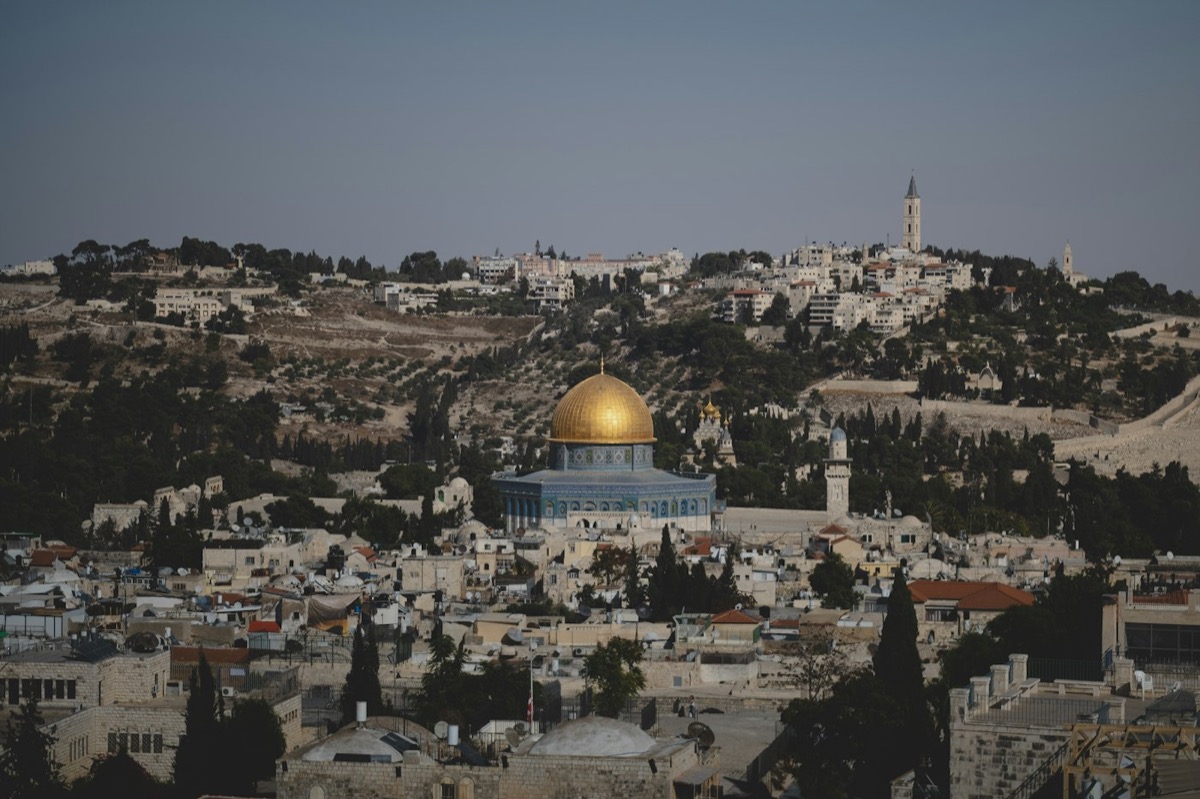
This staged attack organized against Marwan Barghouti in his cell, a few days before the painful anniversary of the burning of Saladin's minbar in the Al-Aqsa Mosque on August 21, cannot be regarded as a coincidence, a passing event; on the contrary, it represents a deep political message.
Barghouti is not merely a prisoner; he is a symbol representing the Palestinian will to resist and to resist captivity. The burned minbar was not merely a piece of wood; it was a cultural and religious symbol representing Jerusalem and its Islamic identity. Both Barghouti and the minbar represent unifying symbols whose presence extends beyond the borders of Palestine to the whole nation.
For decades the occupation has been trying to destroy these symbols. From targeting holy places to attempts to exclude leaders through prisons, the outlines of a consistent policy based on undermining everything that strengthens the Palestinians' national and religious identity are plain. This attack on Barghouti is part of that policy, reaffirming once again that the Palestinians' struggle against the occupation is not only for land but also for memory, symbols and meanings.
However, what Israel intended as a moral blow is turning into an opportunity to renew the support of peoples. While the anniversary of the burning of the Al-Aqsa Mosque minbar recalls the occupation's crimes against holy places, the attack on Barghouti once again draws attention to the issue of prisoners, one of the cornerstones of the Palestinian struggle. The coming together of these two events creates a shared discourse linking Jerusalem and all of Palestine with the prisoners. This message says: however our symbols are targeted, they will remain the fuel that keeps the fire of resistance alive.
Although Barghouti belongs to the Fatah Movement, as a national leader he has been at the top of the lists of prisoners sought to be exchanged in the arduous struggle that Hamas is waging on Palestinian soil. Some differences of opinion among them do not distance them from the common cause, and in particular do not at all require the abandonment of the prisoners; Hamas is very well aware of this and has shown its commitment to it from the outset.
The unity of Palestinian blood and destiny cannot be divided. That some do not support the truth does not mean that the truth will be defeated. On the contrary, just as Almighty God granted victory to His servants in Afghanistan, Bangladesh and Syria, this too is a near victory. The Muslims in Palestine will triumph over the Zionists. This is God's promise.