
← All articles · Palestine and Israel
Palestine: the vanguard of the revival of Islamic civilization
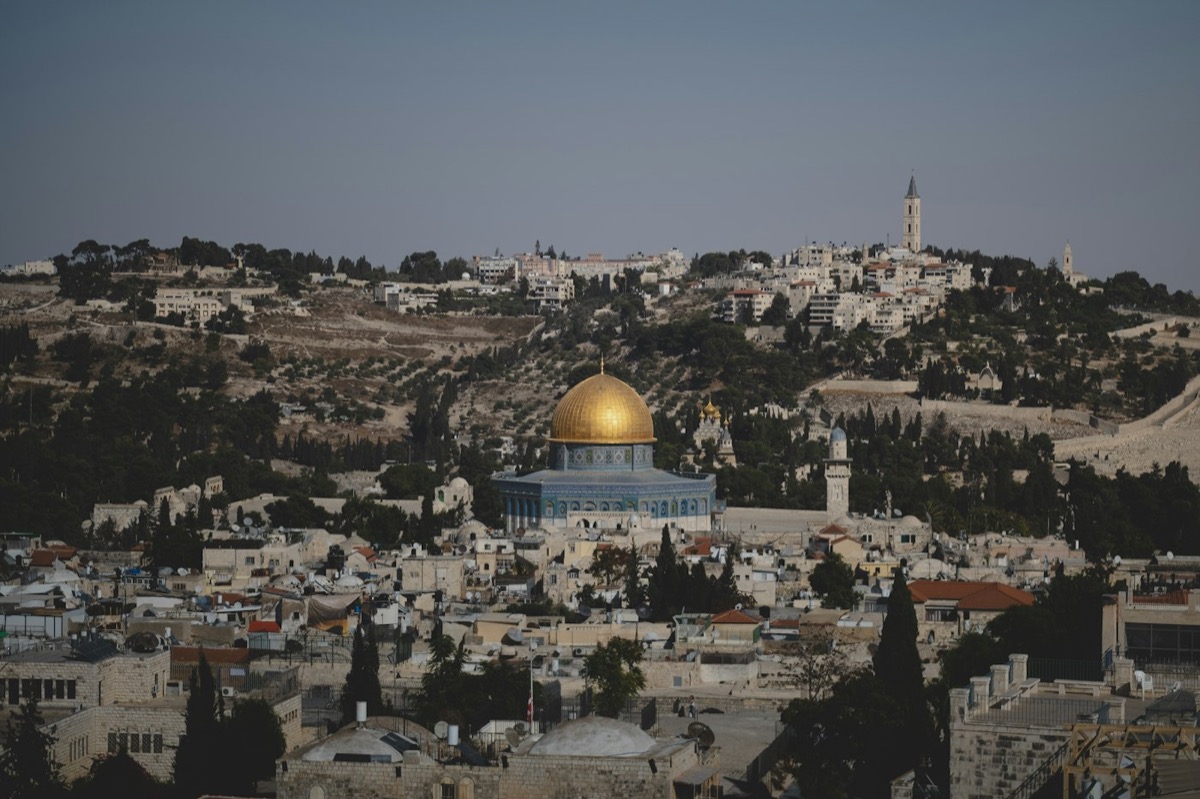
Everyone knows that it is futile to expect the "contemporary," "civilized," "modern" world to act against the inhuman attacks, amounting to genocide, to which Lebanon has been subjected by Zionist Israel after Gaza. The genocidal, occupying Zionist Israel is itself the very substance of this civilization, this contemporaneity and this modernity.
The Zionism project is in essence a project agreed upon by all parties of the world order established as a result of the First World War, which ended in 1918. It certainly has a theopolitical dimension, but it is not reducible to theopolitics. It is also accompanied by a powerful dimension of exploitation and political economy. In the sharing and management of the Middle East's economic resources, Zionism fulfills the function of a keystone for the system. All the states and the order established in the Middle East after the First World War were shaped around this keystone and for it. To think that its only actor is the Jews is one of the things that misleads us most. In both the theopolitical and the economic-political parts of the matter there is a Crusader-Zionist alliance. As to which of these two actors is the overdetermining one, let the post-Marxists get out of that puzzle if they can. That much of a tip from us is enough.
The bigger matter that concerns us is what has happened to the Islamic World in the face of this dominant order. In this order, in which Muslims have become entirely objects and victims, asking "where is the Islamic World?" in the face of every massacre, every oppression and every genocide they suffer, despite their population of two billion, is a routine. Yet it is well known that after the defeat in 1918, and then after the end of its political unity with the abolition of the caliphate in 1924, the Islamic world has had no legal existence.
It has no legal existence, but it could not have been possible for its population of nearly 2 billion not to put forth, even if in fragments, a show of will, a claim to existence. The claim of Islam to exist with its historical experience lived by the Qur'an and with the Prophet's sunnah cannot have been entirely wiped out by historical death sentences. A political unity uniting all Muslims has always existed, even if not at the level of states, at the level of the ummah, at the level of peoples, as a quest, a longing and a will. Because there is prayer, because there is fasting, because there is the Qur'an, and the consciousness of the ummah that these have sown in minds, in hearts, in individual deeds and in the formation of communities could never be destroyed, and has not been. Although the Organization of Islamic Cooperation (OIC) exists as an institution, it does not put forth a presence in the very environment in which it is needed most today. Because the mind of the state(s) running that institution is also bound to the political decision that abolished the Caliphate. It, too, has been neutralized in accordance with the wishes of a world order without Islam. Yet the desire of Muslims as an ummah to be united, and the pain they feel over attacks on any of their organs as one body, is felt most heavily. For this reason, even if there are no states, in their tragic absence the need to be one among Muslim peoples continues to make itself felt.
The Kuala Lumpur Summit, which met about ten years ago under the leadership of former Malaysian Prime Minister Mahathir Mohamad, held its first meetings under the headings "Civil State," "The Effect of Freedom and Democracy on Stability and Development," "Good Governance," and "Transition to Democracy," respectively, headings under which the problems from which the Islamic world suffers were discussed. In fact the OIC never had a claim to be an alternative, but perhaps because of the obvious gap that emerged in the issues and affairs the OIC should be dealing with, the Summit took on such a task by itself. The fifth meeting of the Summit, in December 2019, with the participation of President Erdoğan as well, convened on the theme "The Role of Development in Attaining National Sovereignty." Mahathir Mohamad later described the Summit, attended by a total of 450 leaders, thinkers and intellectuals, as "a small initiative" that he hoped would later expand with larger participation.
The Summit met this time in Istanbul with the Gaza agenda and with a change of name: "Islamic World Thought and Civilization Forum." Thus it appears that care was taken that the findings, diagnoses and proposed solutions concerning all the problems of the Islamic world not be confined to a single country or a single capital but be made the property of the whole ummah.
This time the forum in Istanbul was realized with the contributions of the Center for Islam and Global Affairs (CIGA), directed by Prof. Sami el-Arian at Sabahattin Zaim University, and of the Human and Civilization Movement. The Forum, in which the founding chairman Mahathir Mohamad again took part via video link, was timed to coincide with October 6-7, especially on account of the anniversary of the Al-Aqsa Flood. The theme of the meeting was also conceived as "Palestine, the lever of the revival of civilization for the Islamic ummah."
Indeed, nearly all the participants in the forum regarded the Al-Aqsa Flood as an inevitable model for Islamic awakening, a turning point, a powerful practice of jihad from which the mentality, spirit, will and philosophy behind the Islamic movement could be traced, and an inspiring key for critical thought against the world order.
It was evident that participants from nearly every part of the Islamic world joined the relationship established between this forum and the Al-Aqsa Flood with great excitement and fellow-feeling. The nearly 10-page, 50-article final declaration was in fact a summary of what was discussed throughout the forum. Here, too, I can only content myself with relaying a small excerpt from this summary.
"Islam established a global civilization that is a mercy to humanity. A civilization in which the great majority of all Muslims, with all their sects, sects and honors, took part. When these civilizations collapsed, their political unity was broken, and their societies were fragmented, all of them, with all their sects and races, were harmed.
- The conquest of Jerusalem and the receiving of its keys by the Commander of the Faithful Umar ibn al-Khattab (may God be pleased with him) signaled the practical transition of Islam to its global civilizational dimension, and Palestine and Al-Khattab -the Al-Aqsa Mosque continued to be the cultural compass for Muslims and an indicator of their weakness or strength against hostile international powers.
- The occupation of Palestine by the British is the culmination of the conspiracies of the Western Zionists to overthrow the Ottoman Islamic Caliphate, to end Islamic political unity, to colonize Muslim countries, to prevent their cultural revival, and to perpetuate the backwardness, division and weakness of Muslims.
- Striving to liberate every square centimeter of the occupied Muslim countries is a duty placed on the shoulders of rulers, scholars, leaders and all Muslims, according to their responsibilities, status and capabilities.
- The occupation by the Zionists of the Al-Aqsa Mosque, the first of the two qiblas and the third of the two Holy Mosques, is regarded as the greatest disaster, the greatest scandal and the most dangerous threat known to Muslims in the last century. As long as it is not liberated, there is no security for Islam and Muslims.
- The Zionist entity is a Western colonial project created by Britain and protected by the US in order to safeguard the interests of the West and to prevent Muslims from attaining a civilizational awakening, and there is no way to be rid of this project other than jihad of every kind, including fighting in the way of God.
- Striving to liberate Palestine and the Al-Aqsa Mosque is an obligation for every Muslim man and woman, and a realistic necessity for the security, unity and cultural renaissance of the Islamic nation, and is in the interest of all the countries of the Arab and Islamic world..
- When the Zionist entity settled in Palestine, it was required, for its continuation, to remain superior to all Arab and Islamic countries. Without ending the Zionist occupation, there is no way for any Muslim country to continue permanently and to restart the civilization of the Islamic nation."