
← All articles · Palestine and Israel
Oh Jerusalem, what are you witnessing?
One of the most important aspects of the acts of worship of Ramadan that Muslims observe every year is that it carries a person beyond his individual limits, urging him to transcend his individual existence, his culture, his history, his people, his class belonging and his geographical borders.
While Ramadan fulfills this function, each individual who joins its flow may not perhaps have a very conscious, deliberate orientation; on the contrary, most people, with the arrival of the time of Ramadan, simply playing the role written for them, let themselves be swept into such a process of transcendence.
Thus they send a "greeting" to other people from whom they are estranged in normal life, to the poor, to the stranded, to other peoples, to "those we do not count as our own," to those between whom and us we have placed boundaries in one way or another, and even to those who have long since departed this world. They send this greeting for 30 days in the most practical way possible, through the hunger and thirst they knowingly and willingly choose, feeling for the hungry, the poor and those in anguish, and empathizing with them.
That is why Ramadan brings with it a climate of mercy and blessing not only for Muslims but, through the hands of Muslims, for all people. No harm comes to others from the Muslims' celebration of the festival, only understanding, closeness and selflessness.
When we part the historical veils of the Ramadan traditions that Turkey has traditionally inherited, we see that Ramadan created an environment of encompassing peace, tranquility and understanding not only for Muslim society but together with the non-Muslim communities with whom they lived for hundreds of years, including them as well. The practice of Ramadan also gave Muslims a familiarity with the Advent and Easter of Christians and the Pesach (Passover) of Jews.
No harm, hatred or hostility toward any people arose from the Ramadan observed by Muslims. On the contrary, it ensured a wholeness of social life that was shared together and reached everyone, as it does now. One more difference of Ramadan is the climatic power, blowing at the global level, of a shared experience operating as a habitus, through the structural format that has enabled it to fulfill its main function despite all the time that has passed.
Contrary attacks, again collective, carried out against such a climate, even if they take place in one place, do not disrupt the nature of Ramadan as lived at the global level. Perhaps such attacks, from whomever they come, even revitalize the feature of Ramadan that invites one to transcend the geography and history expected to be formed with it. Of course, though it is never desired, if it will not be counted as too much Durkheimianism, such attacks also have such a function.
In essence, it can be thought that all festivals have such an effect. The observations of the famous German philosopher Hans-Georg Gadamer about festivals in general are of course valid for Ramadan too, but they do not explain how Passover has drifted away from this function as a festival today:
"If there is one thing about all festival experiences, it is certainly the fact that they allow no distinction between one person and another. A festival is an experience of community and represents community in its most perfect form. A festival is for everyone. Therefore, when some do not participate, we say that they are excluding themselves, keeping themselves apart from the festivities."
The days of Ramadan are days that, when lived in its own civilizational basin, succeed in drawing others into a festival atmosphere as well. In this respect it blows an encompassing, embracing, non-excluding festival atmosphere that is not limited to Muslims alone.
Why does Passover, as a festival or holiday, not have such a function too? We have said it before. In fact, a festival in general always refers to a founding event that builds a society and makes being together and belonging to that society meaningful. That founding event also tells how it positions itself in relation to other people. Pesach, that is, Passover, expresses the attainment of freedom by a people living under captivity and oppression. A stand against oppressors, a revolt and a deliverance that follows.
The other of Passover is oppressors, pharaohs, tyrants, not the oppressed, the orphaned, those unjustly driven from their homes and lands, like the Palestinians.
Of course, at Passover it is not expected that only a pharaoh who remained 3,500 years in the past be cursed. The purpose of making that event a festival by the command of the Holy Scripture is to stand, throughout the ages, with the oppressed against every kind of pharaoh. Yet today Israel itself besieges a people and holds them in captivity. Moreover, that people is not one that could in any way be associated, in our age, with any oppression resembling a pharaoh. On the contrary, it is a people who more closely resemble the Children of Israel under the oppression of Pharaoh.
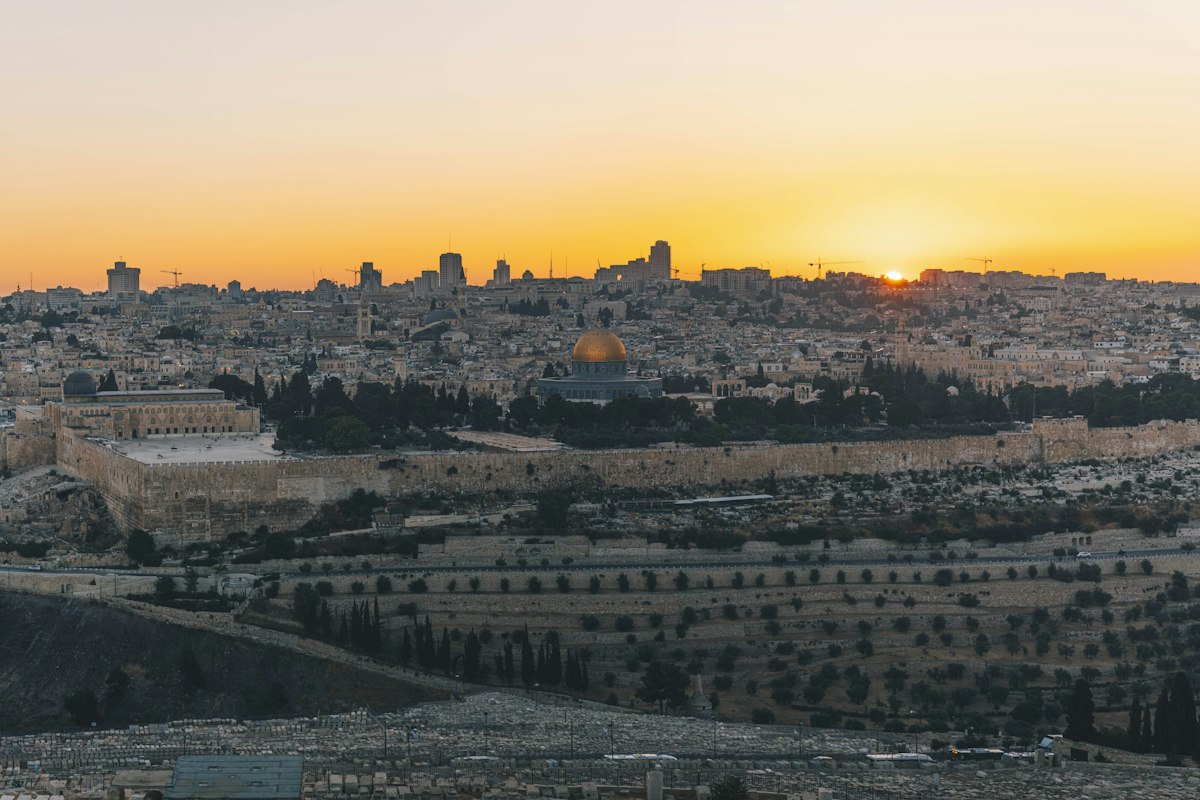
For some time the Israeli government forces, instead of preventing the Jews who want to slaughter their sacrifice at Al-Aqsa Mosque as part of Passover, have been attacking Al-Aqsa Mosque by providing protection for their aggression.
As of yesterday, it also closed the Ibrahimi Mosque in the city of Hebron to the entry of Muslims, and began permitting only the entry of fanatical Jews. The inside and surroundings of the mosque filled with large numbers of fanatical Jews. It was announced by the Israeli forces that this mosque would be kept closed to Muslims until the evening of April 10 because of Passover.
Undoubtedly this is a small link in Israel's aggression, which is not limited to Ramadan alone. The systematic oppression that the occupying forces have inflicted on the entire Palestinian people from the beginning is enough, and more than enough, to make Israel one of the pharaohs of the age. In such a situation Passover, which has completely lost its meaning, has been turned into a community festival as narrow as possible from its universal meaning. A festival that gives a festive atmosphere to no one other than its own fanatical groups, and on the contrary brings others only blood, rancor and tears, cannot be expected to fulfill any sociological function. That is why it is not surprising that one can clearly read, from the darkened faces of those who violate Muslim places of worship using this festival as a pretext, their unhappiness and unease, far removed from the meaning of a festival.
In fact, the point to which Passover as a festival has come, and the fact that Ramadan still continues to repeat its meaning and functions as they are, in accordance with its essence, are also related, in the broadest sense, to the distortion of the book.
The state Passover has reached is the picture of the distortion of a mission of liberation for humanity by people to whom this mission was entrusted.
Ramadan, on the other hand, is the picture of a fidelity, a sign, with all its practices, worship and culture, of perseverance in the mission, of the uninterrupted continuation of a compassion and mercy that will reach all people.
Today Jerusalem is witnessing these two approaches, these two styles.