
← All articles · Palestine and Israel
Words that will reach the world from the minarets of Hagia Sophia
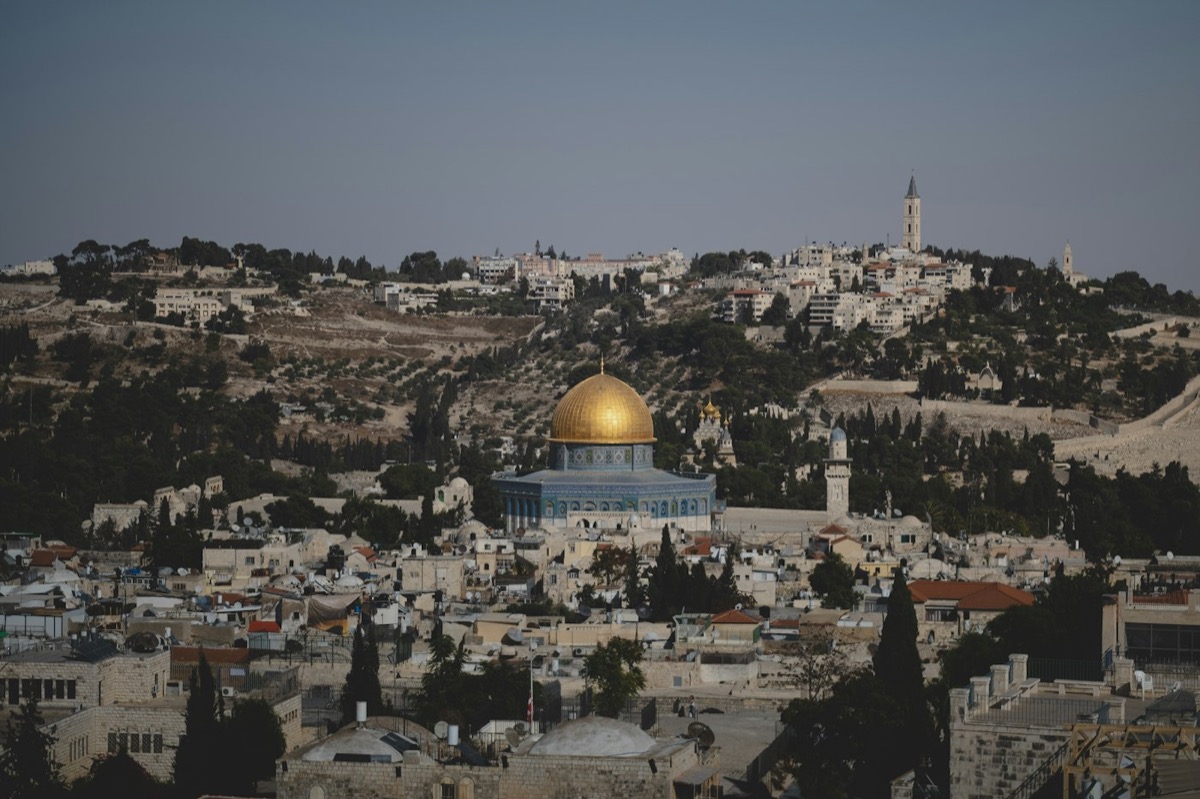
The Hagia Sophia is not a matter of settling today an account that belongs to history and should stay there. It is a matter of reviving the values within it that will benefit the present day and all humanity and shed light in a positive sense.
"The resurrection of the Hagia Sophia is the expression that we, as the Turkish Nation, Muslims and all humanity, have new words to say to the world."
Perhaps the same words can be said through the conquest of Mecca and of Jerusalem, indeed through their conquests. For Jerusalem was conquered twice in history by Muslims, and in both conquests the same path, the same principles, the same values were followed. By contrast, the same Jerusalem experienced for hundreds of years under Muslim administration a perfect example of human rights and of the freedom and coexistence of members of different religions. Yet as a result of the Crusader and Jewish occupations to which it was subjected, it became the scene of humanity's captivity, of difference becoming an object of hatred, of chaos and conflict.
Indeed, during the roughly one century in which it was under Crusader occupation, Jerusalem witnessed a merciless, bloody bigotry in which the Franks among the Christians, let alone other religions, granted no right to life even to any other Christian element, put everyone to the sword and closed their houses of worship.
In the Muslim order that Saladin re-established in Jerusalem, which he conquered again, Jews alongside Muslims, and all the denominations of the Christians too, lived together in security, freely and in peace for another 700 years. This order continued uninterrupted in the period when Jerusalem passed to Ottoman administration, because the Ottomans too were bound to the same spirit and the same principles on this matter.
And look also at Jerusalem's state today under Israeli occupation. A sanctity that is sought to be monopolized by Jews alone, an occupying, arrogant, racist, genocidal bigotry that grants other people neither right nor law, neither respect nor a chance of existence. And this is carried out under the watch of today's contemporary world.
The new world order established with the conquest of Istanbul is only a repetition of the model set forth with the conquest of Jerusalem. There is nothing different there. Fatih is not applying a self-invented model. He applies in Istanbul the model that Islam has applied everywhere throughout history.
"I, the son of the Emir-i Azam Sultan Murad, His Majesty the great Sultan and Emir-i Azam Mehmed Khan, swear by the name of the Creator of earth and sky, by the name of our great Prophet Muhammad, by the name of the Sab'u'l-Mesani in which we Muslims believe, by the name of Allah's one hundred and twenty-four thousand prophets, by the soul of my grandfather and my father, by the name of our sons, by the love of the sword I have girded on," he begins, and gives the covenants that he would later give in Bosnia-Herzegovina and in the places he conquered, to the non-Muslim elements of all the people of Istanbul:
"No one shall obstruct the churches here. The people we have mentioned shall come here, settle comfortably, and use their churches comfortably. No one shall fall into the wrong of causing them distress. Those who fled too may come and settle in my land. No one shall interfere with them. In this land, neither viziers nor subjects nor the people under my protection shall use bad words or behavior toward these persons. This includes me. I swear on the Quran and Allah and all the prophets who have come to the face of the earth that so long as these persons conform to my rulings I will stand behind what I have written to the very end. My words will be fulfilled."
One importance of these covenants is that they did not remain merely words, and that they could be applied successfully and steadily for centuries.
It is a great injustice that Fatih, who repaired the Hagia Sophia that he found in a ruined state and revived its character as a house of worship of Allah in exact accord with the purpose and spirit for which it was founded, is remembered as having converted a church into a mosque. Christians must remember that they lived, in the shade of these covenants, a peace, security and tranquility that they did not live on their own lands for centuries.
Islam is the only religion and worldview that has been able to secure coexistence with other religions by binding it to a law, even in its vision of the future. In the Holy Quran, Jews and Christians or members of other religions are not depicted as groups that will one day vanish entirely and leave the whole stage to Muslims. On the contrary, they are depicted as people who will always exist in the world of Muslims and who have rights.
Yet today, looking at Evangelical and Zionist interpretations, there is a vision of a future in which everyone other than themselves will perish. For Evangelicals, ultimately, there is a millenarian vision of the Kingdom of God in which only Christians survive. Even their serving Israel today stems ultimately not from a love of Jews but from their belief in a scenario in which, at the end of the film, the Jews too will be entirely destroyed. No one will be left but themselves.
Zionist Jews, on the other hand, act with a vision of a future in which they will ultimately rule and everyone else will become slaves with no rights. The human rights practice they display on the lands they occupy today is plain to see. They take revenge for the genocidal practices to which they were subjected in Europe and throughout history on the Palestinians, who throughout history have caused them no harm, no evil.
The routine practices of today's Israel are racial discrimination, a bigotry aimed at granting Muslims and Christians no sphere of existence. And it bases all these practices on the interpretation of its religious texts.
Muslims, with the Hagia Sophia measure, remind the world of a model of religious and ethnic freedom, pluralism and multiculturalism proven by its successful application over centuries.
The Hagia Sophia expresses not a perspective and policy in which Christians are excluded and despised, but on the contrary an inclusiveness in which Christians too are reminded that they are of the same origin as Muslims and are protected with the most deeply rooted tolerance.
Precisely from this, people who do not want to see the Hagia Sophia as a mosque thereby express hatred of Muslims. Yet Muslims preserved the Hagia Sophia as a sign of taking Christians under protection with mercy and compassion, and moreover of saying that there is a continuity between Christianity and Islam.
The Hagia Sophia has been returned to its original identity as a house of worship in which the name of Allah is mentioned and Allah is worshipped.